Qwopus Local AI Coding Model
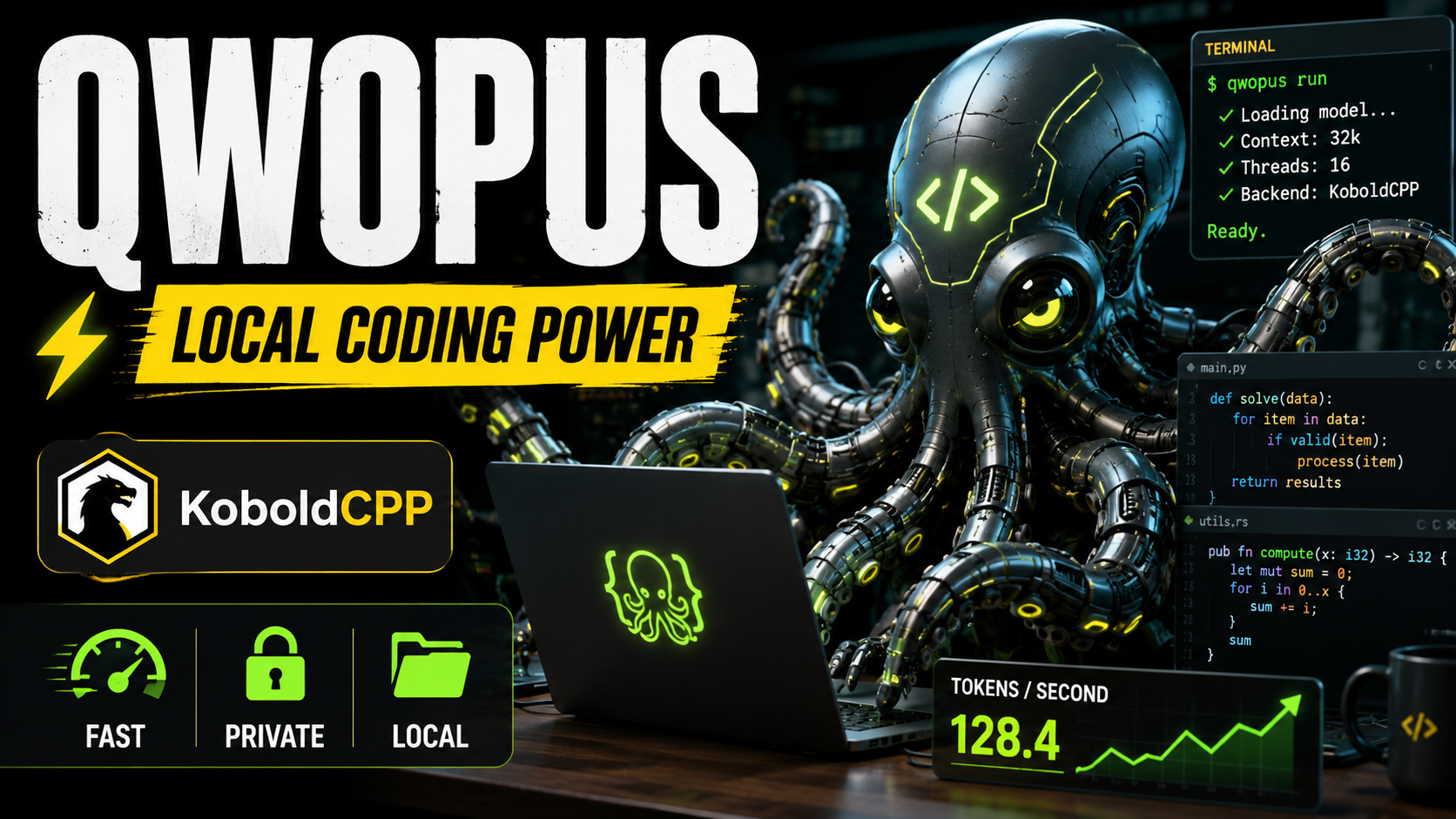
Hey guys! This is a great new model to play with if you love running high-performance coding tools completely local.
Jackrong has released GGUF weights for Qwopus-3.6-27B-Coder-MTP, and this is an exciting one for open-source AI coding. It is especially interesting if you want to see how far local, repository-level coding agents can be pushed without relying on expensive cloud APIs or waiting on high-latency remote calls.
The big story here is local coding-agent performance. Qwopus is built for real coding work, including repository-level debugging, multi-file code edits, terminal workflows, and autonomous agent-style development.
Qwopus-3.6-27B-Coder-MTP has reported strong SWE-bench Verified performance, resolving 67.0% of the full split, or 335 out of 500 tasks. That means it is being tested against real-world GitHub bugs and library issues, not just simple coding prompts.
The other big story is speed. This model can run extremely fast for its size because the reported score was achieved with thinking disabled, and because it uses Multi-Token Prediction heads. Instead of spending a huge amount of time writing out a visible reasoning chain before acting, it can move faster and get straight to the work.
On top-end consumer hardware, this can reach around 100 tokens per second in the right setup. That makes it especially interesting for local coding agents, where speed matters because the model may need to read files, make edits, inspect errors, run commands, and iterate.
The model is based on a dense transformer architecture with 27 billion parameters, using Qwen3.6-27B as the base. It also supports a native 32K context window, which is very useful when working with larger codebases, multiple files, dependency chains, and repository-level prompts.
One of the more interesting technical claims is the use of trace inversion. The creators describe using a specialized Trace Inverter to turn compressed API reasoning logs back into learnable logical paths, then pairing that with roughly 10,000 real-world, multi-turn agent execution traces. Those traces include terminal commands, file edits, tool feedback, and the kind of back-and-forth a coding agent actually needs to handle.
For hobbyists and local AI builders, the point is simple: this is a serious local coding model to experiment with. It is not just for single-file snippets. It is aimed at agent-style code work where the model can help inspect a project, understand what is broken, make changes, and keep moving.
Use the Model Manager to download the correct size for your machine, then run it with an LLM application like KoboldCPP:
FREE FOR ALL FARM HAND MEMBERS.
How to Use
- Download the model using the Model Manager
- Choose the GGUF size that fits your machine
- Download KoboldCPP
- Load the Qwopus GGUF model in KoboldCPP
- Use it for coding prompts, local coding-agent experiments, debugging, and repository-level code work
Included Features
- Qwopus-3.6-27B-Coder-MTP GGUF model support
- 27 billion parameter dense transformer coding model
- Built on the Qwen3.6-27B base
- Native 32K context window
- Multi-Token Prediction support for faster decoding
- Reported 67.0% score on SWE-bench Verified
- Designed for local coding agents and terminal workflows
- Useful for repository-level debugging
- Useful for multi-file code refactoring
- Runs locally through GGUF-compatible applications like KoboldCPP
Requirements
- Windows 10 or Windows 11
- A GGUF-compatible LLM application such as KoboldCPP
- NVIDIA GPU recommended for best performance
- Enough system RAM, VRAM, and disk space for the model size you choose
- Internet connection required for the initial model download
- Use the Model Manager to choose the best size for your machine
Notes
- This is a local AI coding model, not a full standalone app
- Use KoboldCPP or another compatible GGUF runner to load the model
- Performance depends heavily on your hardware, selected quantization, context size, and runner settings
- Smaller GGUF sizes are easier to run, while larger sizes may produce better results
- This is best suited for coding help, debugging, refactoring, agent experiments, and local developer workflows
Get Going Fast provides community setup guidance, documentation, tutorials, troubleshooting support, and member services. Get Going Fast does not sell, host, store, mirror, or redistribute AI model files, model weights, training datasets, or third-party project files.
When a setup guide references third-party dependencies, repositories, or model files, it points users to official upstream public sources such as GitHub, Hugging Face, package managers, or original project repositories, subject to those sources' own licenses, terms, and availability.
Get Going Fast is a general-audience AI education and workflow site, not an adult-content site or hosted AI generation service. Do not use Get Going Fast materials, support, guidance, or referenced third-party tools for unlawful, abusive, non-consensual, sexually explicit, exploitative, harassing, deceptive, or privacy-violating content, including misuse of another person's likeness, voice, identity, intellectual property, privacy, or publicity rights. See our Acceptable Use Policy.
If you are a rights holder, platform reviewer, payment processor, or hosting provider with a concern about a listed tool, guide reference, or upstream source, please contact us. We will review the concern promptly and remove or revise references when appropriate.